

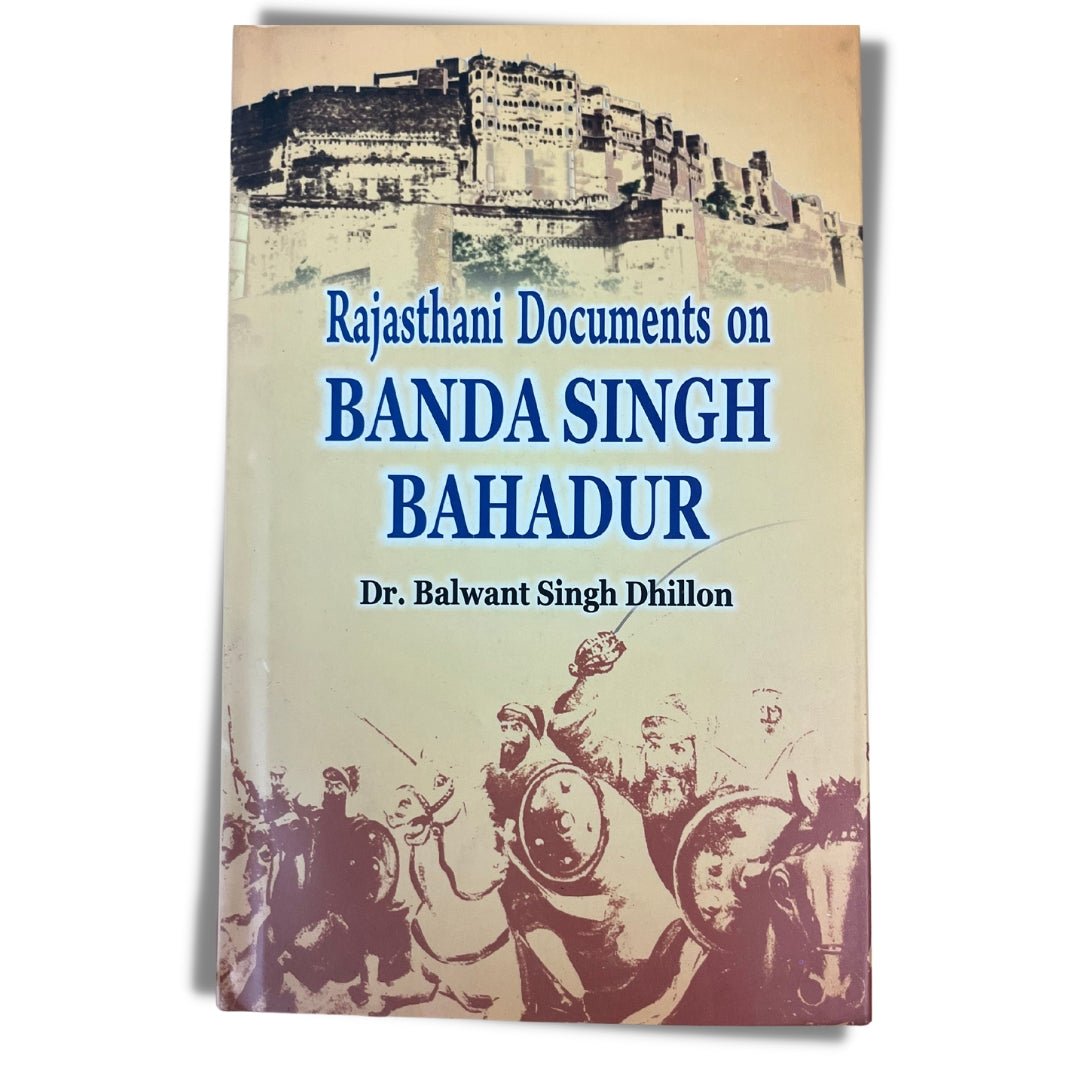
Rajasthani Documents on Banda Singh Bahadur by Dr Balwant Singh Dhillon Book Review
Rajasthani Documents on Banda Singh Bahadur
Dr Balwant Singh Dhillon
Singh Brothers, 2016
318 pages
Introduction
The Rajasthani documents provide valuable information regarding Banda Singh Bahadur. These primary sources help to piece together a rather unbiased understanding of Banda Singh Bahadur.
The evidence offered by the Rajasthani documents is unique because it does not carry the sectarian or religious bias that marks many contemporary Mughal sources.[1] These records do not present Banda Singh Bahadur as an enemy of Islam or as a bloodthirsty figure bent on large scale slaughter of Muslims. Instead, they point to something far more complex. Banda Singh Bahadur allowed Muslims to join his army and they enjoyed complete freedom of worship.[2]
Another striking feature is the way Banda Singh Bahadur is referred to in these documents. Like the Mughal records of the same period, the Rajasthani writers repeatedly call him Guru, Gobind, Guru Gobind and Guru Gobind Singh. The mistake continued throughout the six years of his political activity, from the fourth year of Bahadur Shah’s reign, when Banda Singh Bahadur first appears in the imperial news, to after his execution in Delhi on 9 June 1716 A.D., or 29th Jamadi us Sani, 1128 al Hijri. Of course, Banda Singh Bahadur was not a Guru of the Sikhs. Even so, the persistence of this error reveals the importance both Mughal and Rajasthani chroniclers attached to him. It also makes sense in the context of the leader of the Khalsa having until then been the Guru.
The book itself is divided into six chapters. The first four deal with the historical setting, the chronology and subject matter of the documents, their origin and nature, and the statesmanship of Banda Singh Bahadur. The final two chapters provide English translations of the documents and the original Rajasthani text.
The documents covered in the book run from December 1710 to May 1715. They do not span the whole of Banda Singh Bahadur’s career, but they are still invaluable because they are reports filed by eyewitnesses. Broadly speaking, they fall into three categories. The first are vakil reports, which came from figures roughly equivalent to diplomats. These men represented Rajput chiefs at the Mughal court, observed what was happening there, and acted as channels through which imperial demands were passed on to Jaipur. The second are arzdashts, which were petitions or official communications sent by a subordinate to a superior. In this case, the vakil wrote to his master in Jaipur. The third are kharitas or khatoots. The word kharita comes from Arabic and refers to a pouch. While the term literally describes the pouch itself, the sending of a kharita implied that a royal letter had been placed inside it for confidentiality.[3] Here, these kharitas were exchanged between Rajput states and their officials.
Dr Dhillon makes his position clear from the opening page of the first chapter, where he describes Banda Singh Bahadur as “the founder of the first Sikh rule, (May 1710 - Dec 1715)”.[4] For readers more used to associating Sikh rule with Maharaja Ranjit Singh Ji, that may initially feel surprising. By the end of the chapter, however, it becomes clear why Dr Dhillon frames Banda Singh Bahadur in exactly those terms.
The first chapter moves through the early history of Banda Singh Bahadur and Guru Gobind Singh Ji. It covers Guru Gobind Singh Ji travelling with Bahadur Shah to the Deccan, Guru Gobind Singh Ji’s visit to Madho Das’s abode on 3 September 1708,[5] Madho Das’s conversion to Sikhi as reported in Mughal records, the attack on Guru Gobind Singh Ji by two Pathans, and Guru Gobind Singh Ji’s decision to equip Banda Singh Bahadur with a council of five Singhs, a nishan sahib and a nagara.
The years that follow are set out in strong detail. We are taken through Banda Singh’s administrative control of Samana in November 1709, the Battle of Chapparchiri on 12 May 1710 between Banda Singh Bahadur and Wazir Khan, and the Sikh capture of Sarhind on 14 May 1710.[6] The chapter then widens out to include the rebellion of the Rajput chiefs in November 1709 and shows how Bahadur Shah had to suppress that challenge by June 1710 before he could turn his full attention to Banda Singh Bahadur. From there, the actions of Banda Singh Bahadur and the Sikhs from 22 March 1711 to 9 June 1716 are narrated with impressive depth.
That depth makes the conclusion of the chapter persuasive. As Dr Dhillon argues, “To recapitulate, the Sikh rule established by Baba Banda Singh Bahadur could not last long as it lacked the military resources compared to the Mughal Empire. The foregoing discussions reveal that Banda Singh Bahadur was not only a brave soldier but also an astute statesman who may rightly be called the harbinger of Sikh polity. His rule was no less than a revolution in many of its socio political aspects. Instead of in his own name, he struck the coin in the name of the Guru. In the matter of polity, we can say that he was a forerunner of Maharaja Ranjit Singh.”[7]
Chapter two, titled “Chronology and Subject Matter,” gives a chronological timeline of all the Rajasthani documents included in the book, along with a short description, the document type and the date. There are sixty seven primary sources in total. The first is an arzdasht from Pancholi Jagjiwan Das to Maharaja Jai Singh, dated 26 December 1710. It includes details of Bahadur Shah’s camp in Sadhaura, Banda’s escape into the hills of Nahan, pressure placed on the Raja of Nahan to capture him, and the arrival of Rajput chiefs at the Mughal court. The final document is a vakil report from the same Pancholi Jagjiwan Das to Maharaja Jai Singh on 29 August 1715, which includes information about Emperor Farrukhsiyar’s poor health and the devastation of the pargana of Sirhind by the Sikhs.
Chapter three, “Origin and Nature of the Documents,” explains the character of the documents in more detail. As Dr Dhillon notes, “majority of the documents begin with an invocation such as Sidhi, Shri Gopal Ji Sahay and Shri Ram Ji. then the author resorts to customary salutation to the Maharaja, eulogizes him in superlative terms and then to prove his fidelity and faithfulness pays him his obeisance in a most submissive and humble manner.”[8] From there, the chapter highlights what sets these records apart from Mughal documents. The Rajasthani authors discuss developments at the Mughal court more openly and more fully, offering an unusually honest glimpse into a world of dissension, intrigue and disunity.
The chapter also draws attention to especially important reports. One source from 17 May 1711 suggests that Mughal authority had been pushed back into urban centres, while the countryside had passed into Sikh hands. Another, dated 1 June 1711, observes that no Mughal noble was willing to take on the Sikhs. A vakil report from 9 May 1711 states that Banda had established his camp at Kalanaur and that many Hindus and Muslims were joining him. Most strikingly of all, these documents suggest that Banda hoped to form an alliance with the Rajput Rajas in order to liberate the country from the Mughals.[9]
Chapter four, “Statesmanship of Banda Singh Bahadur,” builds directly on that point. It advances the historically grounded argument that Banda Singh Bahadur “was not only a military commander but also an astute statesman.”[10] The chapter focuses on Sikh Rajput relations, Banda’s communication with Rajput rulers, the Mughal treatment of the Raja of Nahan, and the episode in which a letter from Banda to Sawai Raja Jai Singh II of Jaipur fell into Mughal hands.
The fifth and sixth chapters are more straightforward in structure but no less valuable. One gives English translations of the documents and the other reproduces the original Rajasthani text, allowing the reader to move between source and translation.
What makes the book especially compelling, though, is the way these documents illuminate the political climate around Banda Singh Bahadur. They show both his public appeal and the Mughal reaction to it. A vakil report of 9 May 1711 states that Banda Singh Bahadur had established his camp at Kalanaur and that many Hindus and Muslims were joining his army. A report from 28 May 1711 reveals the Mughal response. Villages were destroyed because local people had joined Banda Singh Bahadur’s uprising.
The urgency with which the Mughals sought to capture him runs through the documents with remarkable force. Arzdasht No. 195 of 26 December 1710 and Vakil Report No. 21 of 10 January 1711 both call for Banda’s capture. By 19 January 1711, Vakil Report No. 23 suggests there was confidence that he would be taken quickly. On 27 January 1711, Vakil Report No. 25 records the emperor ordering Mahabat Khan and Munaim Khan to proceed with an armed contingent and produce Banda Bahadur. On 4 February 1711, Vakil Report No. 27 states that he would be “captured in a day or two and produced in court.” On 6 March 1711, Vakil Report No. 351 notes that Hamid Khan Bahadur and Isfandyar Khan departed with fifteen thousand cavalry to liquidate him.
Even the emperor’s personal movements were shaped by the campaign. Vakil Report No. 49 of 2 April 1711 records that Bahadur Shah was suffering from baltod, boils caused by uprooting the hair, and that this slowed the imperial advance towards Lahore. On 4 April 1711, Vakil Report No. 50 states that the emperor declared he would march personally to suppress the Sikhs. Vakil Report No. 51 of 18 April 1711 places him at Chhatt Banur, waiting for a bridge to be built across the Sutlej before continuing. On 26 April 1711, Vakil Report No. 52 records Nawab Rustam Dil Khan asking that the campaign against Banda be assigned to him while the emperor remained at the river.
By June 1711, the language of crisis becomes unmistakable. Arzdasht No. 203 of 9 June 1711 speaks of the crisis created by Banda Singh Bahadur. On 26 August 1711, the issue had become so serious that it was explicitly labelled a crisis. People could lose the emperor’s favour for failing to pursue him, while anyone who succeeded in doing so would receive rewards beyond description.[11] Two days later, on 28 August 1711, Banda is said to have left the emperor openly “upset” because he kept fighting and slipping away from capture.[12]
The documents also show that intelligence was pursued ruthlessly. Vakil Report No. 23, dated 10 January 1711 and referring to an arzdasht, states that “Diwan of the Raja, who is a Sikh, was arrested and beaten severely and consequently his survival is very difficult.”[13] Another entry from 19 January 1711 notes that the mother of the Raja of Nahan had been imprisoned because of her son’s failure to capture Banda Singh Bahadur. On 4 February 1711, a further report states that she petitioned the emperor to free her son, arguing that Banda could be captured from the hills under her authority. Yet by 8 February 1711, another report makes clear that Banda fought back and escaped.
One of the most chilling details in the entire collection is the creation of a special iron cage for him. Vakil Report No. 25, dated 27 January 1711, says Mahabat Khan was ordered to “bring Banda to the court in an iron thorny cage that had been made solely for this purpose.” Vakil Report No. 37, dated 8 February 1711, explains that the cage had nails on all sides so that the prisoner would be forced to remain standing. A later report, dated 17 March 1711, adds that the nails inside were sharp and hard.
At the same time, the documents leave no doubt about the strength of the Sikhs. On 20 March 1711, Vakil Report No. 46 declares that Shamas Khan and Bayzid Khan had both been killed in battle and that the power of the Sikhs was rising. Four days later, Vakil Report No. 48 says that the Sikhs had once again risen in Guru Ka Chak, Amritsar, and had established their rule as far as Shahdara near Lahore.
Just as importantly, the documents suggest that Banda Singh Bahadur’s movement had wide support and deeply disturbed Mughal rule. On 1 March 1711, Vakil Report No. 33 notes that because of the Sikh uprising, no one dared venture out of the cities. On 7 March 1711, Vakil Report No. 311 records that the Sikhs of Banda had established such strong sway around Lahore that the market formerly held outside the city had to be moved inside it. On 13 March 1711, Vakil Report No. 44 states that the royal army began its march because the Sikhs of Banda at Amritsar had beaten back Shamas Khan and Bayzid Khan, who had gone there with fifteen hundred men on foot and horseback, and that the Sikhs were now preparing to march on Lahore.
Taken together, these documents do far more than add detail to an already known story. They reshape the way Banda Singh Bahadur can be understood. They show him as a leader with real public appeal, real political ambition and real strategic ability. They also reveal just how seriously the Mughal state took the threat he posed. That is what makes this collection, and Dr Dhillon’s treatment of it, so valuable.
Conclusion & Rating
Dr Balwant Singh Dhillion has done a great service in translating and providing access to a collection of primary sources regarding Banda Singh Bahadur. This book deservedly gets a 5 star rating.
It is thoroughly researched and well documented, referring extensively to Mughal and Sikh historical sources to verify and provide further context to the Rajasthani documents. Extensive footnote lists are found at the end of each chapter.
Furthermore, the required contextual and supplementary information required to understand these primary sources is provided in great detail. Finally, the primary sources written in a pre-modern Devanagari script sources are included alongside translated copies in English.
If you are serious about unfiltered history and want to deal with primary sources, this is a must for your book collection.
I have used it in trying to piece together a more complete story of Banda Singh Bahadur and will be releasing it soon.
Have you got yours?
Get your copy here.
Footnotes
[1] Rajasthani Documents on Banda Singh Bahadur, Dr Balwant Singh Dhillon, 2016. Page 12
[2] Rajasthani Documents on Banda Singh Bahadur, Dr Balwant Singh Dhillon, 2016. Page 32
[3] The Art of Kharita Dispatching in the Late 19th Century Afghanistan, https://euppublishingblog.com/2019/05/01/the-art-of-kharita-dispatching-in-the-late-19th-century-afghanistan/
[4] Rajasthani Documents on Banda Singh Bahadur, Dr Balwant Singh Dhillon, 2016. Page 15
[5] Dr Dhillon references the Amarnama for this date.
[6] Rajasthani Documents on Banda Singh Bahadur, Dr Balwant Singh Dhillon, 2016. Page 25
[7] Rajasthani Documents on Banda Singh Bahadur, Dr Balwant Singh Dhillon, 2016. Page 31-33
[8] Rajasthani Documents on Banda Singh Bahadur, Dr Balwant Singh Dhillon, 2016. Page 57
[9] Rajasthani Documents on Banda Singh Bahadur, Dr Balwant Singh Dhillon, 2016. Page 60
[10] Rajasthani Documents on Banda Singh Bahadur, Dr Balwant Singh Dhillon, 2016. Page 67
[11] Rajasthani Documents on Banda Singh Bahadur, Dr Balwant Singh Dhillon, 2016. Vakil Report No. 265, Page 149
[12] Rajasthani Documents on Banda Singh Bahadur, Dr Balwant Singh Dhillon, 2016. Vakil Report No. 81, Page 154
[13] Rajasthani Documents on Banda Singh Bahadur, Dr Balwant Singh Dhillon, 2016, page 81